EXERCISE 9.1 Solutions
Question 1.
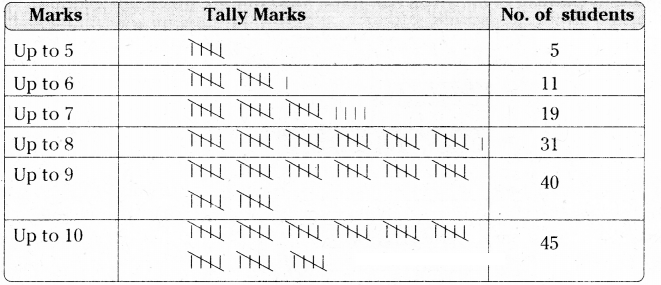
Write the mark wise frequencies in the following frequency distribution table.

Solution
Question 2.
The blood groups of 36 students of IX class are recorded as follows.

Represent the data in the form of a frequency distribution table. Which is the most common and which is the rarest blood group among these groups ?
| Blood group | A | B | AB | O |
| Frequency | 10 | 9 | 2 | 15 |
From the table, most common group is O and rarest group is AB.
Question 3.
Three coins were tossed 30 times simultaneously. Each time the occurring was noted down as follows :

Prepare a frequency distribution table for the data given above.
Solution:
| No. of heads | 0 | 1 | 2 | 3 |
| Frequency | 3 | 10 | 10 | 7 |
Question 4.
A T.V. channel organized a SMS (Short Message Service) poll on prohibition on smoking giving options like A - complete prohibitions, B - prohibition in public places only, C - not necessary. SMS results in one hour were

Represent the above data as grouped frequency distribution table. How many appropriate answers were received ? What was the majority of people’s opinion ?
Solution:
| Options | A | B | C |
| Frequency(f) | 19 | 36 | 10 |
Total appropriate answers received = 19 + 36 + 10 = 65
Majority of people’s opinion is prohibition in public places only i.e., B.
Question 5.
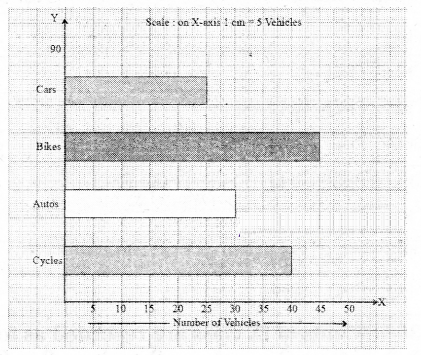
Represent the data in the given bar graph as frequency distribution table.
Solution:

Question 6.
Identify the scale used on the axes of the given graph. Write the frequency distribu- tion from it.
Solution:
Frequency distribution table :
| Class | No. of students |
| I | 40 |
| II | 55 |
| III | 65 |
| IV | 30 |
| V | 15 |
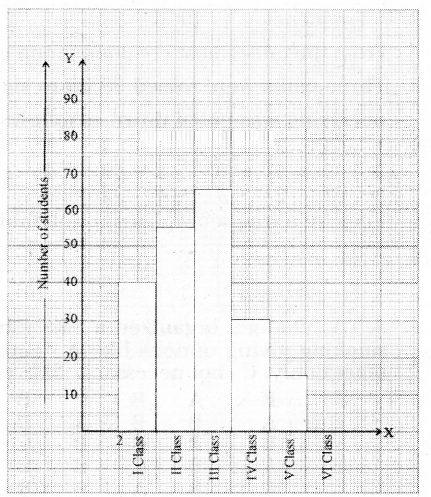
Scale : X - axis : 1 cm = 1 class interval
Y - axis : 1 cm = 10 students
Question 7.
The marks of 30 students of a class, obtained in a test (out of 75), are given below : 42, 21, 50, 37, 42, 37, 38, 42, 49, 52, 38, 53, 57, 47, 29, 59, 61, 33, 17, 17, 39, 44, 42, 39, 14, 7, 27, 19, 54, 51. Form a frequency table with equal class intervals.
(Hint: One of them being 0 - 10)
Solution:

Question 8.
The electricity bill (in rupees) of 25 houses in a locality are given below. Construct a grouped frequency distribution table with a class size of 75.
170, 212, 252, 225, 310, 712, 412, 425, 322, 325, 192, 198, 230, 320, 412, 530, 602, 724, 370, 402, 317, 403, 405, 372, 413.
Solution:
The least value of observations = 170
The height value of observations = 724

Question 9.
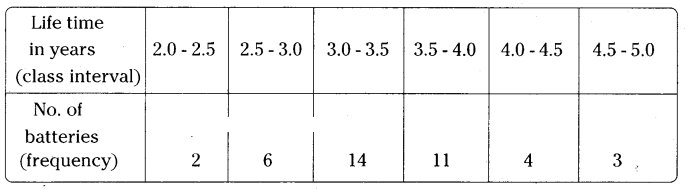
A company manufactures car batteries of a particular type. The life (in years) of 40 batteries were recorded as follows.
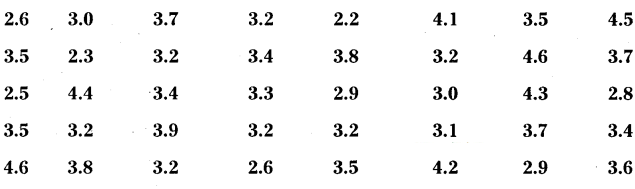
Construct a grouped frequency distribution table with exclusive classes for this data, using class intervals of size 0.5 starting from the interval 2 - 2.5.
Solution:
----------------------------------------------------------------------------------------------------------------------
EXERCISE 9.2 Solutions
Question 1.
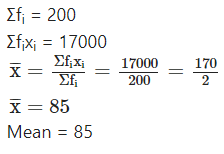
Weights of parcels in a transport office are given below.

Find the mean weight of the parcels.
Solution:
| Weight in kg xi | No. of parcels fi | x1fi |
| 50 | 25 | 1250 |
| 65 | 34 | 2210 |
| 75 | 38 | 2850 |
| 90 | 40 | 3600 |
| 110 | 47 | 5170 |
| 120 | 16 | 1920 |
Question 2.
Number of familles In a village in correspondence with the number of children are given below.

Find the mean number of children per family.
Solution:
| No. of childrens xi | No. of families fi | x1fi |
| 0 | 11 | 0 |
| 1 | 25 | 25 |
| 2 | 32 | 64 |
| 3 | 10 | 30 |
| 4 | 5 | 20 |
| 6 | 1 | 5 |
Σfi = 84
Σfixi = 144
x=Σfixi/Σfi = 144/84
Mean = 1.714285
Question 3.
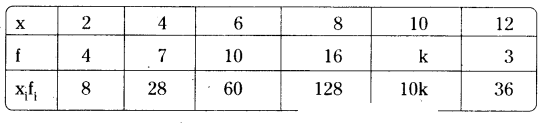
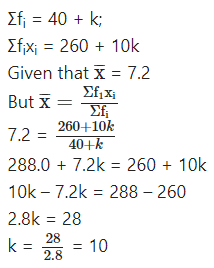
If the mean of the following frequency distribution is 7.2, find value of ‘k’.

Solution
Question 4.
Number of villages with respect to their population as per India census 2011 are given below.

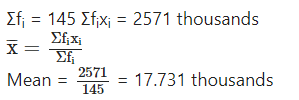
Find the average population in each village.
Solution:
| Population (in thousands xi) | Villages fi | x1fi |
| 12 | 20 | 240 |
| 5 | 15 | 75 |
| 30 | 32 | 960 |
| 20 | 35 | 700 |
| 15 | 36 | 540 |
| 8 | 7 | 56 |
Question 5.
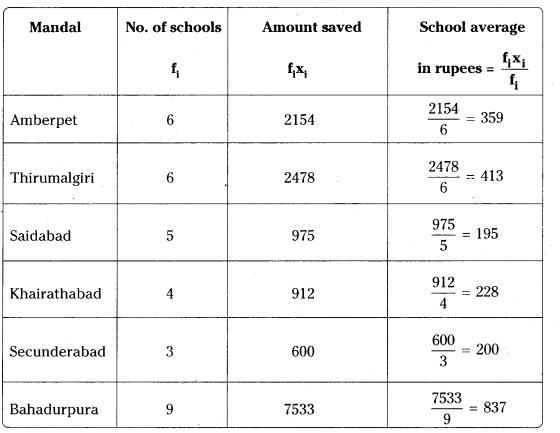
A FLATOUN social and financial educational programme initiated savings programme among the high school children in Hyderabad district. Mandal wise savings in a month are given in the following table.
| Mandal | No. of schools | Total amount saved (in rupees |
| Amberpet | 6 | 2154 |
| Thirumalgiri | 6 | 2478 |
| Saidabad | 5 | 975 |
| Khairathabad | 4 | 912 |
| Secunderabad | 3 | 600 |
| Bahadurpura | 9 | 7533 |
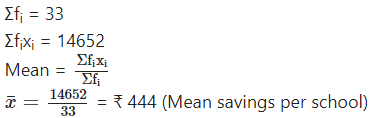
Find arithmetic mean of school wise savings in each mandal. Also find the arithmetic mean of saving of all schools.
Solution:
Question 6.
The heights of boys and girls of IX class of a school are given below.

Compare the heights of the boys and girls.
[Hint: Fliid median heights of boys and girls]
Solution:
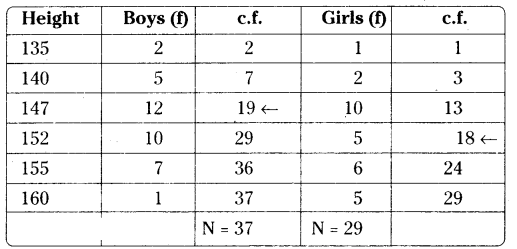
Boys median class =37+1/2 = 38/2 = 19th observation
∴ Median height of boys = 147 cm
Girls median class =29+1/2 = 30/2= 15th observation
∴ Median height of girls = 152 cm
Question 7.
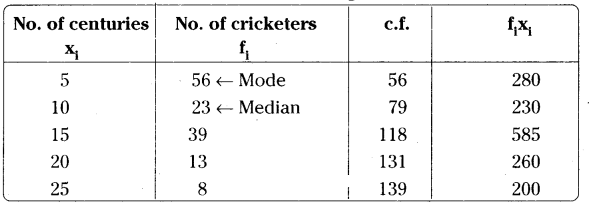
Centuries scored and number of cricketers in the world are given below.

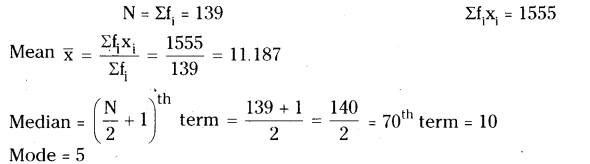
Find the mean, median and mode of the given data.
Solution:
Question 8.
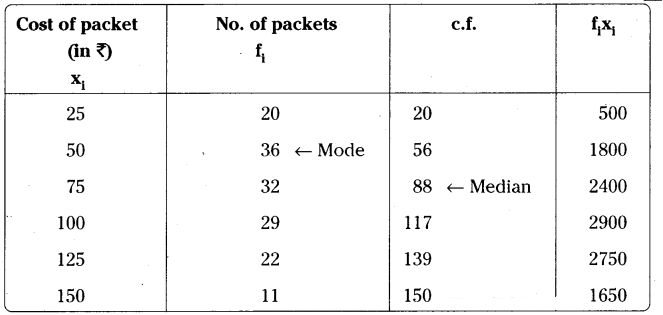
On the occasion of New year’s day a sweet stall prepared sweet packets. Number of sweet packets and cost of each packet is given as follows

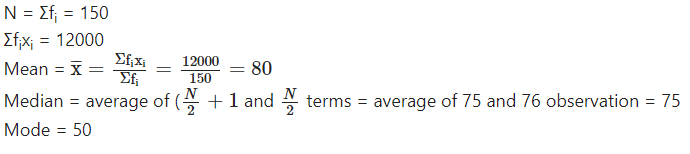
Find the mean, median and mode of the given data.
Solution:
Question 9.
The mean (average) weight of three students is 40 kg. One of the students Ranga weighs 46 kg. The other two students, Rahim and Reshma have the same weight.
Find Rahim’s weight. cgigB)
Solution:
Weight of Ranga = 46 kg
Weight of Reshma = Weight of Rahim = x kg say
Average = Sum of the weights/Number= 40kg
∴ 40 = 46+x+x/3
3 x 40 = 46 + 2x
2x = 120 - 46 = 74
∴ x =74/2 = 37 .
∴ Rahim’s weight = 37 kg.
Question 10.
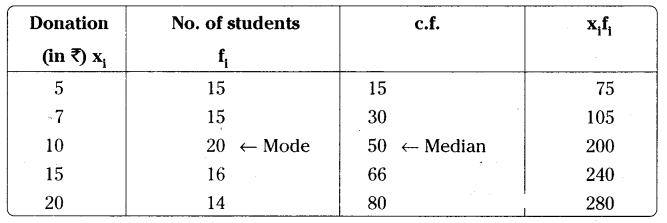
The donations given to an orphanage home by the students of different classes of a secondary school are given below.
| Class | Donation by each student in (Rs) | No. of students donated |
| VI | 5 | 15 |
| VII | 7 | 15 |
| VIII | 10 | 20 |
| IX | 15 | 16 |
| X | 20 | 14 |
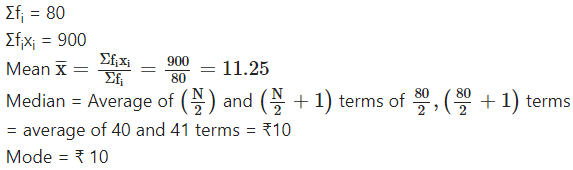
Find the mean, median and mode of the data.
Solution:
Question 11.
There are four unknown numbers. The mean of the first two numbers is 4 and the mean of the first three is 9. The mean of all four numbers is 15; if one of the four numbers is 2 find the other numbers.
Solution:
We know that mean = sum / number
Given that, Mean of 4 numbers = 15
⇒ Sum of the 4 numbers = 4 x 15 = 60
Mean of the first 3 numbers = 9
⇒ Sum of the first 3 numbers = 3 x 9 = 27
Mean of the first 2 numbers = 4
⇒ Sum of the first 2 numbers = 2 x 4 = 8
Fourth number = sum of 4 numbers - sum of 3 numbers = 60 - 27 = 33
Third number = sum of 3 numbers - sum of 2 numbers = 27 - 8 = 19
Second number = Sum of 2 numbers - given number = 8-2 = 6
∴ The other three numbers are 6, 19, 33.